
100 Subscribers and Semi-Annual Reporting
A Hearty Thank you!

To begin, I just want to say a sincere thank you to everyone who has subscribed to the Conviction Queue. When I started this newsletter a few months ago, I really had no idea where the journey would take me or what my initial plans would evolve into. It has been incredibly rewarding to see that my pieces are connecting with so many of you, and I deeply appreciate your support.
The goal of the Conviction Queue is always to provide readers and investors with thoroughly researched ideas, regardless of whether I personally own the underlying stock. However, I believe in transparency and will always clearly disclose the businesses that have a place in my own portfolio.
What I recently discovered is that the average investor spends a mere six minutes analyzing a stock idea before making a decision. You can see some of these statistics which were wild to me:
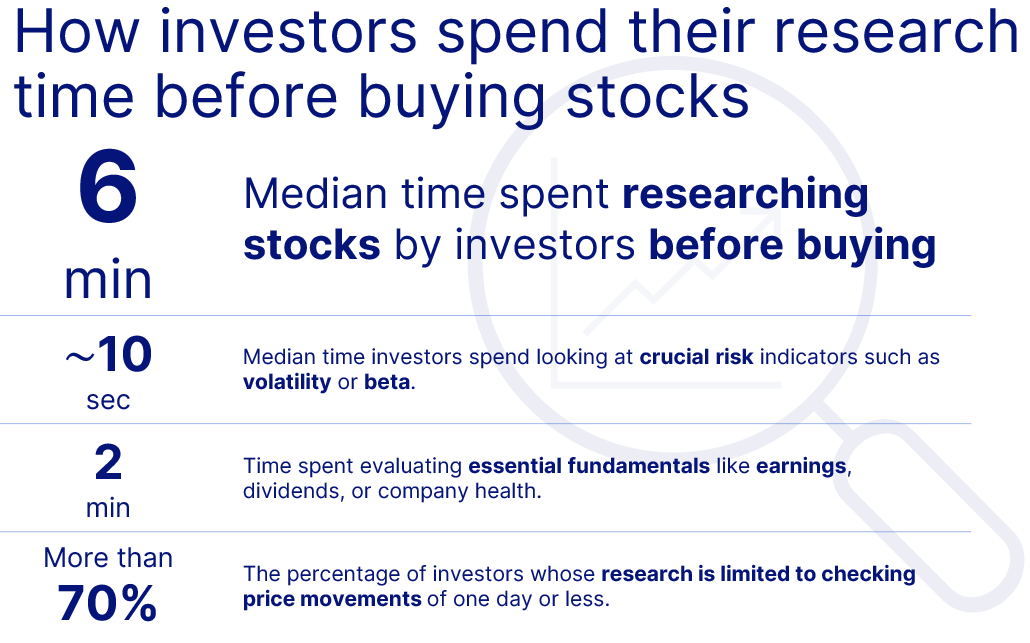
Personally, I spend way more time peeling back the layers of a business, and I highly encourage other investors to do the same. If you find yourself short on time, my goal is to provide articles you can read that offer a comprehensive baseline, helping you quickly determine if a company warrants a deeper look on your end.
Ultimately, successful investing requires figuring out exactly which game you are playing. Morgan Housel discusses this concept extensively in his podcast and his book, "The Psychology of Money." The internet is filled with competing philosophies, from short-term options trading to high-yield dividend investing. There are countless ways to navigate the market.
Because of this, it is vital to find your “tribe” or the people who share your core investing philosophy. It is a mistake to compare your returns or process to others, especially if they are playing an entirely different game. If you are a nimble, short-term trader, you gain very little by tracking someone buying dividend stocks. Similarly, an investor approaching retirement will look at the world through a completely different lens than a 20-year-old just starting out.
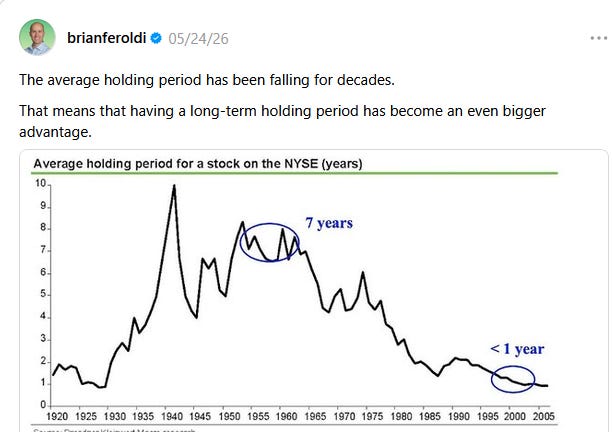
My personal philosophy centers on identifying high-quality businesses that can compound capital for the long term. When I say long term, I am thinking in terms of years, and if the compounding engine remains intact, decades. As this graphic by Brian Feroldi illustrates, the long-term holding period has gone down dramatically but I think that’s an advantage for patient long-term investors:
That said, I will never marry my stocks blindly. Part of the discipline is consistently checking under the hood to ensure these companies remain worthy of my time and my capital.
If that long-term, high-conviction approach aligns with your goals, please keep following along. If you have any specific companies or industries you would like me to research in the future, please drop them in the comments below!
Also, if you believe a friend or family member would be interested in the Conviction Queue, please share:
Semi-Annual Reporting: A Step Backward for Transparency?
The second topic I want to address today is a significant regulatory shift on the horizon. The SEC has introduced a proposal regarding semi-annual reporting, and I want to share a high-level summary of what this means for individual investors.
For investors unaware, Paul Atkins has taken the reins of the SEC from Gary Gensler. Atkins, who was selected by the Trump administration to lead the agency, is taking a starkly different path than his predecessor. Where Gensler favored a highly prescriptive, rule-oriented approach, stricter environmental regulations, and a skeptical eye toward cryptocurrency, Atkins is shifting the focus entirely. The administration has discarded ESG reporting initiatives, placing its primary focus on a clear mandate: "Make IPOs Great Again."
As part of this effort to lower barriers to entry for public markets and reduce regulatory burdens, the SEC is introducing a major change. Many public companies will soon have the options to file a Form 10-S (a semi-annual report) instead of the standard Form 10-Q (the traditional quarterly report). This effectively cuts their periodic financial reporting obligations in half, requiring just one 10-K and one 10-S per fiscal year (Here is a summary from PwC that goes into more detail about this proposal).
Proponents argue that quarterly earnings releases trap senior leadership and CEOs in a short-term mindset, and that moving to a semi-annual schedule will give management the breathing room to focus on long-term corporate objectives.
Now I don’t buy that argument. Truly elite, long-term companies are already built to ignore the noise from an earnings release. This is especially true for founder-led businesses, which happen to be my preferred hunting ground. Visionary founders do not manage their companies to hit artificial quarterly estimates. Consider someone like Rick Smith at Axon. While he certainly wants the company to perform well every quarter, his real, decades-long mission is eliminating gun violence. When you back founders with that scale of long-term vision, the quarterly reporting schedule is not an impediment to their success.
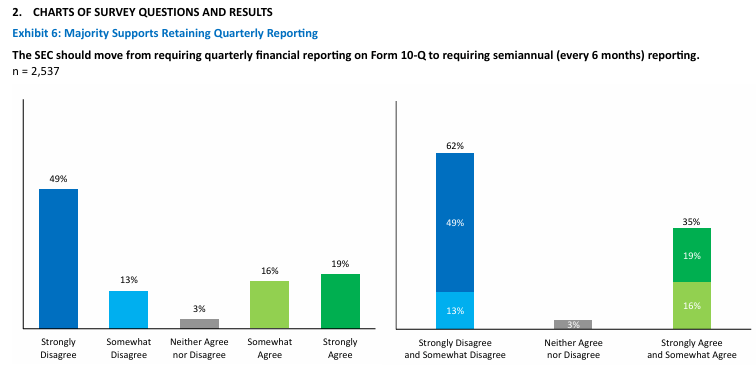
Furthermore, data compiled by the CFA Institute indicates that retail investors overwhelmingly prefer quarterly reporting:
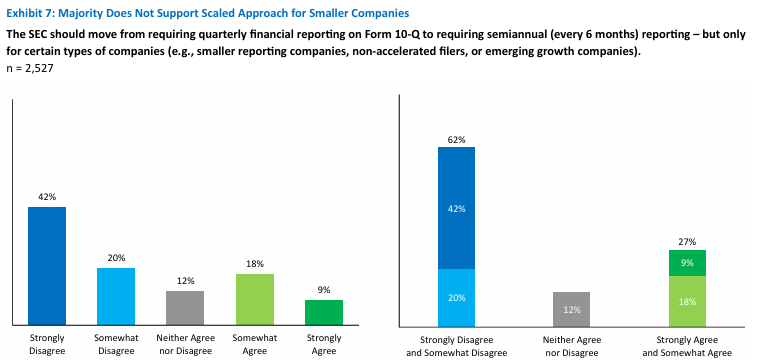
Additionally, investors don’t support the breaks this proposal would give to smaller companies:
I understand the desire to create reporting efficiencies and reduce the reporting burden for companies as I used to work on external reporting teams for a few public companies and now I work as a consultant in external financial reporting. I've worked in the industry for nearly two decades and I would argue the compliance burden is lower than it has ever been.
In the age of AI and automation, modern tools have streamlined disclosure workflows tremendously. Even a massive enterprise like Apple or Meta can present its quarterly financials in under 100 pages, which is remarkably lean for businesses of that scale. Companies can also easily leverage specialized third-party providers to optimize their reporting without needing to overhaul their internal architecture.
For individual investors, less transparency will not eliminate market uncertainty but it will amplify it. Less frequent data means a higher probability of earning surprises, sharper market reactions, and heightened stock volatility, a combination few long-term investors welcome.
The Motley Fool has been actively encouraging investors to voice their perspectives on this issue. I have already submitted my formal comment to the SEC advocating for the preservation of quarterly data, and I strongly urge my subscribers to do the same if you value having consistent access to timely financial disclosures:
Submit your comments to the SEC - Here
Okay, end of rant. Once again, thank you all for helping this newsletter cross the 100-subscriber milestone. It truly does mean the world to me. I will be back with our regular deep dives next week. If there is a particular business you want me to analyze, let me know in the comments.
Happy investing!
Share your comments below:
Huge congrats! You're likely the most similar in ideology to me on the platform so far as I've found and I appreciate your write ups. Its freaking mind-blowing that the average "research" is six minutes. I spend dozens if not hundreds of hours on my companies, I really get to know them intimately. Ideally I should be able to have a conversation with the CEO about the business and hold my own, at least for a few minutes! 100 subs is amazing and I'm proud to have connected with you :) also thanks for including the link to the SEC, I'd rather stick to quarterly but it doesn't bother me too much.
Congrat!